Induction or ceramic hob: how to choose
Induction or ceramic: speed, electricity, cookware, safety, noise and connection explained simply, based on independent tests, public agencies and EU data. With advice on which type suits whom.

Both look the same: black glass with marked zones. The difference is under the glass, and it affects speed, safety, cookware and price. We compared data from independent testers (Stiftung Warentest, Which?, CHOICE, Consumer Reports), public agencies and EU documents to make the choice simple.
In short
- Induction heats the pan itself: water boils faster, the glass around the pan gets less hot and it is easier to clean. You need pans with a magnetic base.
- Ceramic heats the glass with glowing elements: any flat-based pan works, but it is slower and stays hot for a long time after switching off.
- Electricity: induction uses a little less, but the yearly saving is small (tens of euros, not hundreds). The main gains are speed, control and safety.
- Price: in our range a 60 cm induction hob costs about the same as a ceramic one (from ~175 € in October 2026).
How they work
Induction. Under the glass are coils carrying alternating current at roughly 20-100 kHz. This creates a magnetic field that induces eddy currents in the base of the pan, so the pan itself heats up[6][1]. The glass only warms up from the hot pan.
Ceramic (radiant hob). Heating elements under the glass glow red and the heat passes through the glass into the pan[19][1]. So the glass gets hot too and cools down slowly after switching off.
Comparison
Speed
After switching off
Noise
Electricity: how much you really save
Induction is more efficient because the heat is created in the pan. ENERGY STAR (US) says induction transfers about 85% of the energy to the pan and is 5-10% more efficient than conventional electric hobs[10][11]. The German Environment Agency calls induction the most efficient choice, but notes that the gap is large when heating up and shrinks during longer simmering[5]. The EU Joint Research Centre found only a small difference in consumption between induction and ceramic[12].
A practical example: Stiftung Warentest estimated that a household using 10 kWh a week on a conventional hob needs about 8 kWh with induction[3]. That is about 100 kWh a year, for example about 20 € a year at 0.20 €/kWh. A nice bonus, but not a reason to buy on its own; speed, control and safety matter more.
Hobs have no EU energy label[13]. There are only minimum requirements: an electric hob may use no more than 195 Wh per kilogram of water in a standardised test[14]. The Commission is reviewing the rules, with new requirements planned around 2028[15].
Cookware: the magnet test
Induction needs a ferromagnetic base: cast iron, enamelled steel and stainless steel with a magnetic base. If a magnet sticks to the base, the pan will work[10][1]. Aluminium, copper, glass, ceramic and non-magnetic stainless steel do not work unless the maker added a magnetic base[21][22].
Manufacturers advise against induction adapter plates: Miele warns they can damage the induction generators, and Bosch's manual forbids them[22][21]. If you own a lot of good aluminium or copper pans, add the cost of new cookware or choose ceramic.
Almost any pan works on ceramic, as long as the base is flat and sits firmly on the glass[1].
Safety: children, heat and pacemakers
On an induction hob the glass around the pan reaches 45-60 °C, compared with 90-120 °C next to heating coils[4]. The pan itself is just as hot, so turn handles away from the edge. Induction does not heat without a pan, switches off after a set time and has overheat protection[18][11]. A ceramic hob stays hot after switching off, shown by the residual heat indicator[24]; Which? says this makes it less suitable for families with young children[19].
Used correctly, the magnetic field stays within international ICNIRP reference levels; BfS recommends keeping 5-10 cm from the front edge and from an active zone[6]. The Swiss Federal Office of Public Health also advises placing the pan in the centre of a zone of matching size[7].
If you have a pacemaker or an implanted defibrillator, talk to your cardiologist before buying. Advice varies: manufacturers' manuals say 10-30 cm[23], the British Heart Foundation recommends at least 60 cm[9]. In a study, the risk was higher when standing very close and with the pan off-centre; keeping 35 cm reduced the effect to a safe level in every measurement[8]. Ceramic hobs have no such magnetic field.
Noise
Induction can hum or whistle, especially at high power, the electronics may click and the cooling fan runs[20][22]. The sound often depends on the pan: Stiftung Warentest notes that some pots buzz and you only find out when cooking[1]. It is not a fault. A ceramic hob is practically silent.
Connection
A 60 cm induction hob usually has a total power of about 7.4 kW and can be connected to one, two or three phases as described in the manual[23]. Ceramic hobs have similar power. A hob without a plug needs a dedicated circuit with an all-pole isolator, and only a certified electrician may connect it[23][25].
Smaller 2-zone (30 cm) hobs need less power, so they suit summer houses and limited supplies. Before buying, check how many phases and what fuse your kitchen has. We can install and connect the hob.
Cleaning and durability
Both hobs use the same glass ceramic. Remove sugar, jam and melted plastic straight away with a scraper, otherwise they can leave damage[24][21]. Lift pans instead of sliding them: rough bases, salt and sand cause scratches[21]. On induction, spills hardly burn on because the glass gets less hot[1].
Which to choose
Young children at home
Induction: cooler glass around the pan, automatic switch-off and child lock.
You cook often and want speed
Induction with Boost: water boils about twice as fast as on ceramic.
Lots of aluminium, copper or glass pans
Ceramic, or induction plus a new set of pans.
Pacemaker
Talk to your cardiologist; the option without a magnetic field is ceramic.
Summer house or limited supply
A 2-zone (30 cm) hob: available as induction and as ceramic.
Small kitchen, no room for a hood
An induction hob with an integrated extractor.
Our range
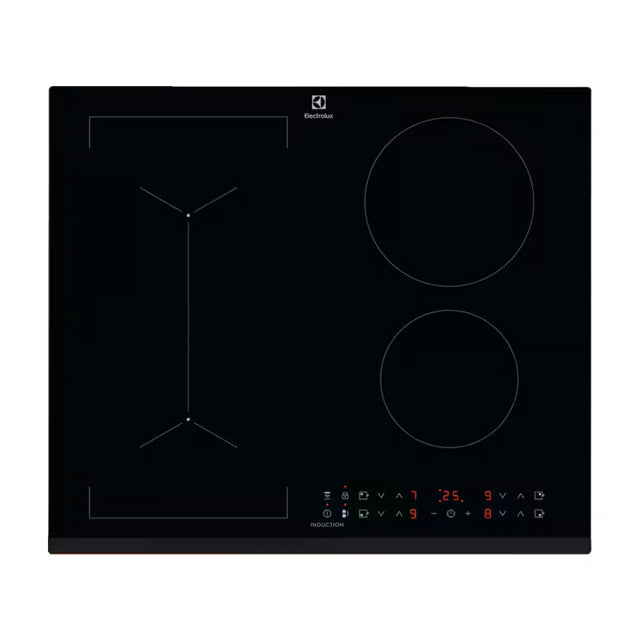
We have 23 induction hobs from 30 to 90 cm, including 6 with an integrated extractor: all induction hobs. Ceramic models: Berk BHV 3002 T/YK (2 zones), Berk BHV 6001 T/YK and Electrolux EHF6547FXK (4 zones). All hobs, including gas and combined: built-in hobs.
Available now · in stock in Riga
Induction hobs available now
The most purchased models that are in our warehouse. Order on a working day by 17:00 and collect within 1 hour. The list updates automatically.
Frequently asked questions
Does induction really save electricity?
A little. Independent data show about 5-20% lower use, mostly when heating up. In the Stiftung Warentest example it is about 100 kWh a year, which is tens of euros, not hundreds.
How do I check whether my pan works on induction?
Hold a magnet to the base. If it sticks firmly, the pan works. If it does not stick or sticks weakly, the pan will not heat or will heat poorly.
Can I use an adapter for my old pans?
Manufacturers (Bosch, Miele) advise against adapter plates: they can damage the hob electronics and cooking becomes slower.
Is induction harmful to health?
Used correctly, the magnetic field stays within ICNIRP limits. Agencies advise keeping 5-10 cm from an active zone and placing the pan in its centre. People with a pacemaker should ask their doctor.
Why does my induction hob hum?
Humming at high power, clicks and fan noise are normal. A lot depends on the pan: multi-layer bases tend to hum more.
Does induction need three phases?
Not necessarily. Many hobs can be connected to one, two or three phases as the manual says. A certified electrician chooses and makes the connection.
Why don't hobs have an energy label?
There is no EU energy label for hobs. There are only ecodesign requirements (Regulation 66/2014), which the European Commission is now reviewing.
Sources. Facts checked on 5 October 2026. Manufacturer manuals were used only for use and connection facts.
Show sources (25)
- Stiftung Warentest (23 Oct 2025): induction, radiant or gas (DE)
- Stiftung Warentest (23 Oct 2025): induction hobs tested (DE)
- Stiftung Warentest (26 Sep 2013): is induction better? (DE)
- Stiftung Warentest (30 Jan 2014): induction and child safety (DE)
- German Environment Agency UBA (10 Nov 2025): cookers and hobs (DE)
- BfS, German Federal Office for Radiation Protection (13 Jan 2026): induction cookers (DE)
- Swiss Federal Office of Public Health (1 Feb 2026): induction cooker fact sheet (DE)
- Irnich, Bernstein (2006), EP Europace: pacemakers and induction cooktops
- British Heart Foundation: induction hobs and pacemakers
- ENERGY STAR (US EPA): electric cooking products
- US Department of Energy: making the switch to induction
- EU Joint Research Centre (JRC, 2022): preparatory study on cooking appliances
- European Commission: energy-efficient products, hobs
- Commission Regulation (EU) No 66/2014 (ecodesign: ovens, hobs, range hoods)
- European Commission: review of ecodesign requirements for cooking appliances (initiative 13688)
- CHOICE (26 Mar 2026): induction vs ceramic cooktops
- Which?: how to buy the best hob
- Which? (17 Dec 2025): things to know before switching to induction
- Which?: best ceramic hobs
- Consumer Reports: pros and cons of induction cooktops
- Bosch: induction hob user manual (cookware, cleaning)
- Miele: KM 7897 FL operating instructions (cookware, adapters, noises)
- Electrolux EHH6540FHK: user manual (7.4 kW, connection, pacemakers)
- Electrolux EHF6241FOK: ceramic hob user manual (residual heat)
- Sadales tīkls (Latvian grid operator): electrical safety at home (LV)
See also: Induction hobs · All hobs · Installation and connection · All guides